
AI in the Back Office was a bet with no evidence behind it
Nobody knew how much autonomy sellers would accept from AI, and the roadmap was already filling with AI features.
- Phase one: 118 sellers answer. What they want AI to take on, and how much autonomy they would hand it.
- Phase two: the frontline checks. The same findings, replayed to the Seller Success Managers who hear sellers complain.
- Suggest and confirm: where both phases landed.
A designer’s survey alone would not carry a decision this contested. The survey closed at 118 responses, and the findings held across both phases.
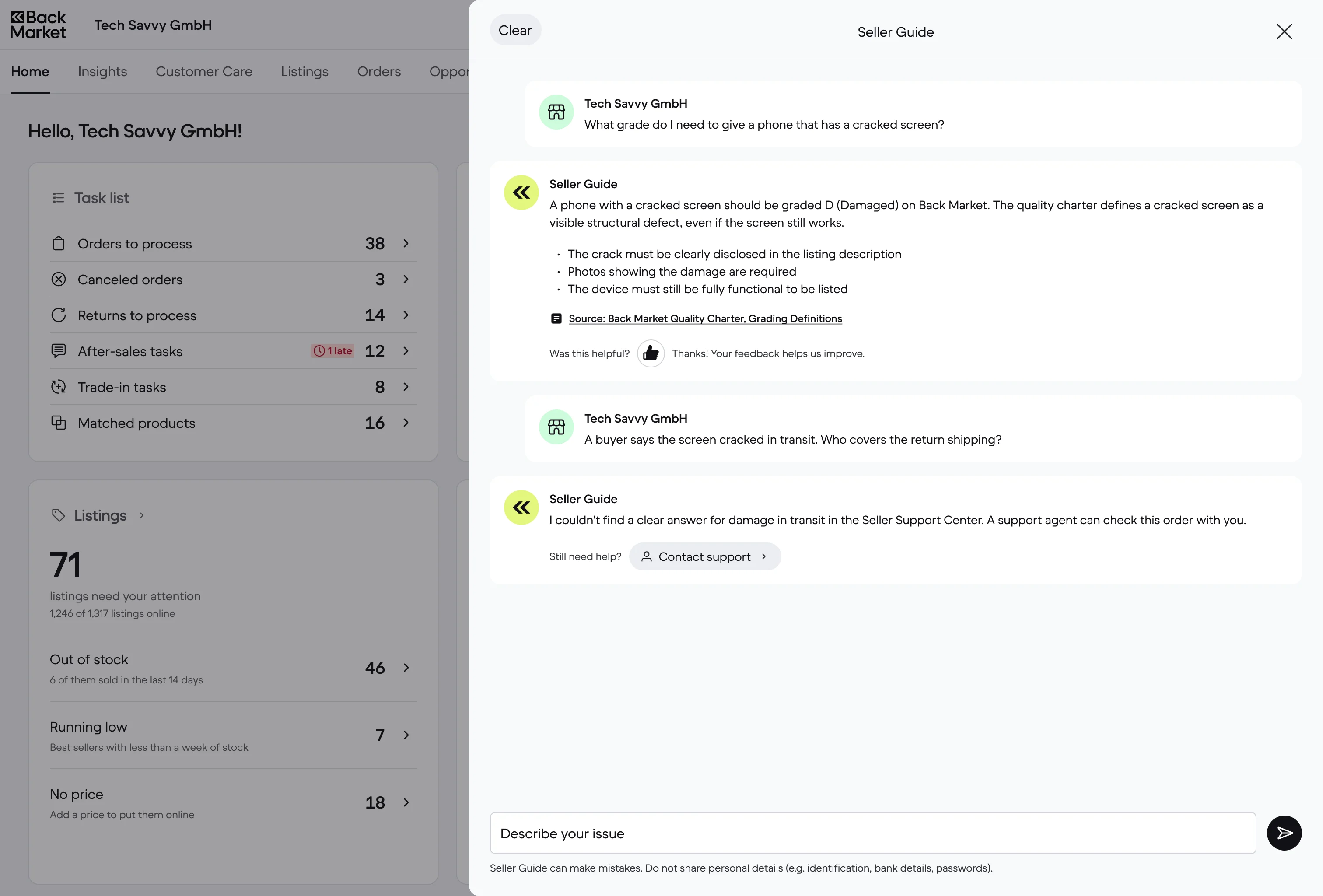
Seller Guide answers a seller’s question, or hands it to a person
It is an AI assistant inside the Back Office, the tool Back Market sellers use to run their shop.
- AskIn the Back OfficeThe seller asks in plain words, next to the page they are working on.
- Sourced answerFiltered by countryEvery answer cites its source and applies to the seller’s own market.
- Rate itOne tapThe seller says whether it helped. The pilot never collected this signal.
- Hand overThree rulesNo answer or a thumbs down leads to a person. A failed call gets a retry.
Two in three sellers want to keep the final say
Sellers were not afraid of AI. They were unwilling to be automated over.
- already 54%
- Of sellers use AI tools in their business
- scored 6.9
- Out of ten: the value sellers place on AI in the Back Office
- about 52%
- Made per-action accept-or-reject control their top condition for trust
- only 6%
- Reject AI in the Back Office outright
suggest and confirm: 69% keep the final say
The smallest group of all is the one that wants no AI at all. The posture almost named itself.
Sellers want a time-saving tool that supports decisions, not something that replaces them.
Seller Success Manager validation round, February 2026
AI suggests and the seller confirms
- Rejected
Automated pricing decisions and autonomous listing changes- Chose
- Suggest and confirm: AI proposes, the seller approves
Suggest and confirm is not a limitation to outgrow. It is the product. That sets the real design bar: an accept step fast enough that autonomy stops being the thing sellers ask for.
The no-go list. AI proposes, the seller approves. Nothing reprices or edits a listing on its own.
- 01 Alerts & monitoring: Kept, build first
- 02 Listing-quality assistant: Kept, build first
- 03 Performance digest: Kept, build first
- 04
Automated pricing decisions: No. Price suggestions, the seller accepts each one. - 05
Autonomous listing changes: No. Proposed edits, confirmed one by one.
The no-go list mattered most: a designer saying no, with evidence, while the roadmap pressure ran the other way.
Automated pricing decisions. Autonomous listing changes.
The assistant speaks first, with the seller’s own data
- Rejected
An assistant that only answers when asked- Chose
- Proactive scenarios, grounded in the seller’s actual data
Each scenario names the cause, offers one fix, and leaves doing nothing as a real option. The consistency is the argument: suggest and confirm as a system, not case by case. The scenarios are concept mockups on placeholder data.
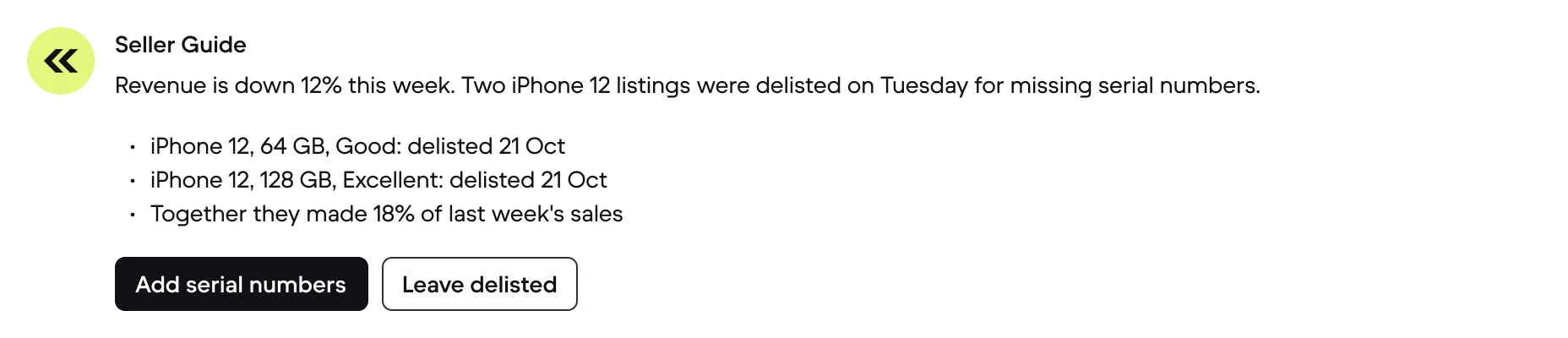
01 Revenue dip.
- Trigger:
- Revenue down, traced to two delisted iPhone listings.
- Suggests:
- Relist them, with the delisting reason shown.
- Seller decides:
- Relist, or leave delisted.
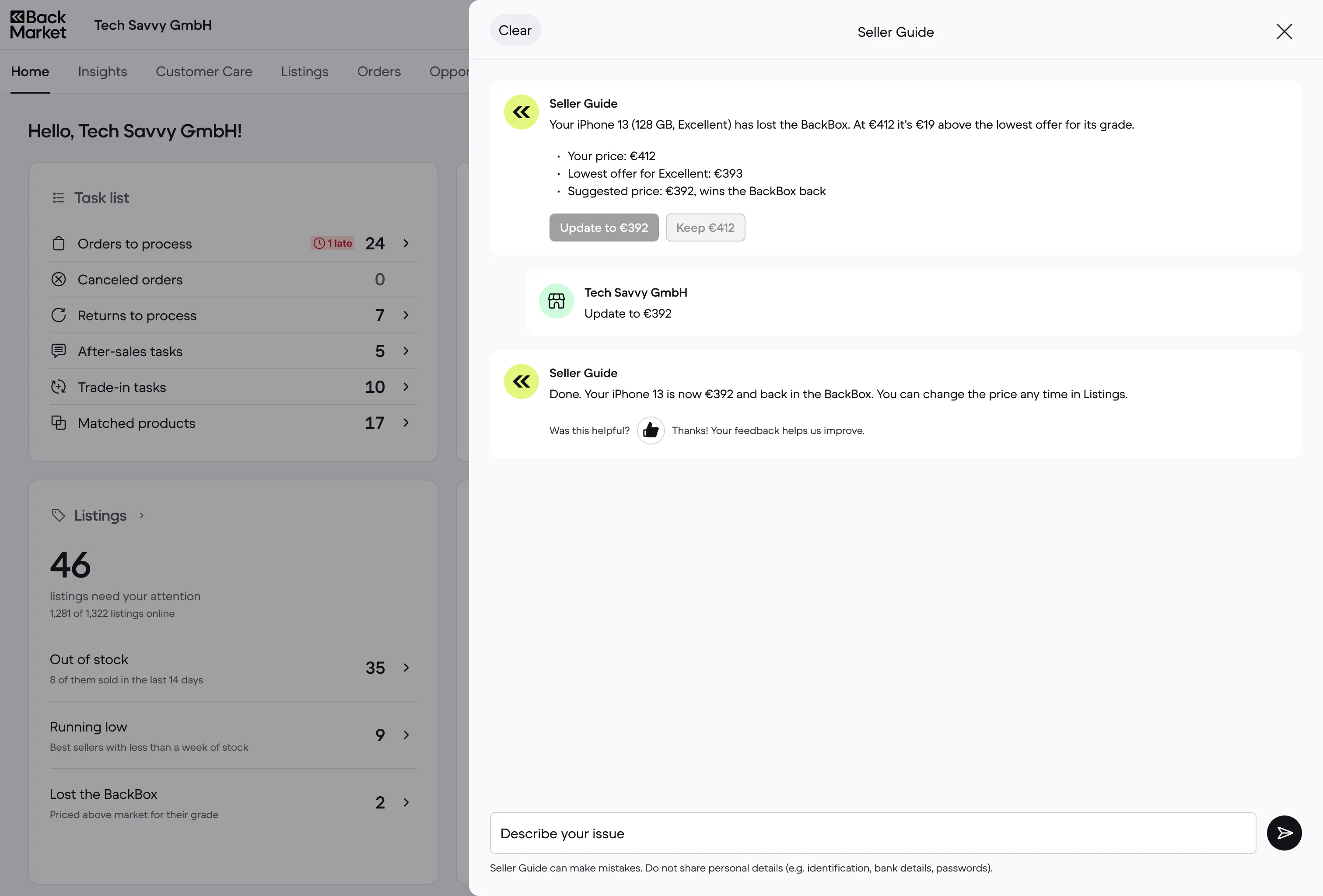
02 Price drift.
- Trigger:
- A listing losing the BackBox, priced above market for its grade.
- Suggests:
- A new price, with the math shown.
- Seller decides:
- Accept the price, or keep their own.
03 Ship-by risk.
- Trigger:
- Orders approaching today’s ship-by deadline.
- Suggests:
- The orders listed, oldest first.
- Seller decides:
- Open them, or snooze.
A reactive Q&A assistant that only answers when asked.

A stuck seller gets a person
- The pilot
Answers with no signal whether the seller got help or gave up- Chose
- Three simple rules: a stuck seller gets a person, a failed call gets a retry
The pilot went live with about 200 UK sellers in January. It proved demand but was not built to last. My part of the co-written spec: the seller-facing layer, with answer feedback, three-rule escalation to a person, and answers filtered to the seller’s country.
- 44%
- Of the pilot’s first 117 conversations ended after a single exchange, with no signal whether the seller got an answer or gave up
- 8.5%
- Of pilot sellers explicitly asked the chatbot for a human
- 01 If the assistant has no answer, offer a person, immediately.
- 02 If the seller rates the answer down, offer a person.
- 03 If the call fails, retry.
An answer, with no way to rate it.



The recommendation became Back Market’s 2026 strategy
“The Nov 2025 ‘AI in the [Back Office]’ study (118 sellers) backs the suggest-and-confirm posture.”
“What we will not do: launch AI without a human override. Suggest-and-confirm is the 2026 standard.”
Back Market’s 2026 seller strategy, quoted verbatim
In practice the report broke a stalled prioritisation, moved three features to the front of the queue, and wrote the prototype’s scenarios into the chatbot’s plan.
The bet is still being tested, against bars set before the data
The rebuilt chatbot shipped as the Seller Assistant.
Each step up from here is gated. Pass or fail, the next revision of this case study reports against them.
- To advise on seller data, it must clear this bar:40% help requests deflected,3.5 of 5 seller satisfaction
- To act on a seller’s behalf, the bar rises:60% help requests deflected,4.0 of 5 seller satisfaction,under 2% harmful actions
What I’d do differently so far
The study measured what sellers say, not what they do. Sellers who say they want an accept step may stop wanting it the tenth time they tap it.
Run again, the survey would ship with a prototype in sellers’ hands, so the accept-or-reject finding meets real behaviour before it becomes strategy.
Evidence first, then a prototype, then the spec
- Survey118 sellersHow much autonomy sellers would accept from AI, and what they wanted it to take on.
- Frontline checkReplayed to SSMsThe same findings, tested on the people who hear sellers complain.
- PrototypeCoded, not mockedThree proactive scenarios built with agentic coding tools, on placeholder data.
- SpecCo-writtenAnswer feedback, escalation to a person, and answers filtered by country.