AI suggests.The seller decides.
- Role
- Senior Product Designer (Design Lead)
- Timeline
- Q4 2025 – Q2 2026
- Working with
- Cross-team Chatbot Taskforce: Product Managers, Seller Success Team, Engineers, Data Analyst
- Status
- Live
The short version. How much autonomy should AI have in the Back Office, where professional sellers run their entire Back Market business? I settled the question with evidence: a two-phase study, 118 sellers cross-validated with the teams who support them. The posture it produced, suggest and confirm, is now Back Market’s stated AI strategy for 2026, and I am turning it into product.
Outcome 118-seller study → stated AI strategy for 2026
AI in the Back Office was a strategic question nobody had evidence for. The company wanted to move fast, and the real risk was building the wrong AI: over-automating in ways sellers would not trust, or under-building and missing the moment. There was no data on what sellers actually wanted AI to do, or how much autonomy they would accept.
I took the ambiguity on directly, as a product designer rather than a researcher by title. That is the point of this story: a contested, politically loaded question turned into an evidence question, and the answer turned into the company’s adopted AI posture.
Sellers in the study that set the posture
Every response cross-checked with the teams who support sellers every day.
Evidence before roadmap
A designer’s survey alone would not carry a decision this contested, however clean the data. So the validation was two-phase by design: sellers first, then the people who hear them complain. The survey closed at 118 responses, and the findings held across both phases.
How the evidence was built
Credibility by construction: the second phase exists so the first can be believed.
- already 54%
- Of sellers use AI tools in their business
- scored 6.9
- Out of ten: the value sellers place on AI in the Back Office
- about 52%
- Made per-action accept-or-reject control their top condition for trust
- only 6%
- Reject AI in the Back Office outright
How much autonomy sellers give AI
The autonomy split across the 118-seller study, at the study’s own proportions.
Sellers were not afraid of AI. They were unwilling to be automated over. Two in three keep the final say for themselves, and the smallest group of all is the one that wants no AI at all. The posture almost named itself.
The cross-validation round said the same thing in its own words.
Sellers want a time-saving tool that supports decisions, not something that replaces them.
Seller Success Manager validation round, February 2026
Suggest-and-confirm, with a no-go list
The report recommended suggest and confirm: AI proposes, the seller approves. Not a limitation to outgrow but the product itself, which sets the real design bar: an accept step fast enough that autonomy stops being the thing sellers ask for. With the posture came a recommended roadmap, and two lines of it got struck out.
The no-go list is the part I’d defend hardest: a designer saying no, with evidence, while the roadmap pressure ran the other way.
The no-go list
AI proposes, the seller approves. Nothing reprices or edits a listing on its own.
The roadmap went through the product’s own posture: proposed, and the seller evidence decided.
The recommendation became strategy
Back Market’s 2026 seller strategy, quoted verbatim
“The Nov 2025 ‘AI in the [Back Office]’ study (118 sellers) backs the suggest-and-confirm posture.”
“What we will not do: launch AI without a human override. Suggest-and-confirm is the 2026 standard.”
The marked words are the report’s own.
In practice the report broke a stalled prioritisation, moved three features to the front of the queue, and wrote the prototype’s scenarios into the chatbot’s plan. That is decision-impact, and I claim it as exactly that — whether the posture drives adoption as the features ship is the test still ahead.
From posture to prototype
The posture then had to become product, and the design side of that is mine. The working artefact is a coded prototype — code over Figma for speed: scenarios could be reworked directly, and a working link lands harder than a clickthrough. Concept one is where we are: a reactive Q&A assistant. Concept two is where we want to be: proactive, grounded in the seller’s actual data.
Six proactive scenarios make up the concept set. The consistency is the argument: suggest and confirm as a system, not case by case.
The six scenarios
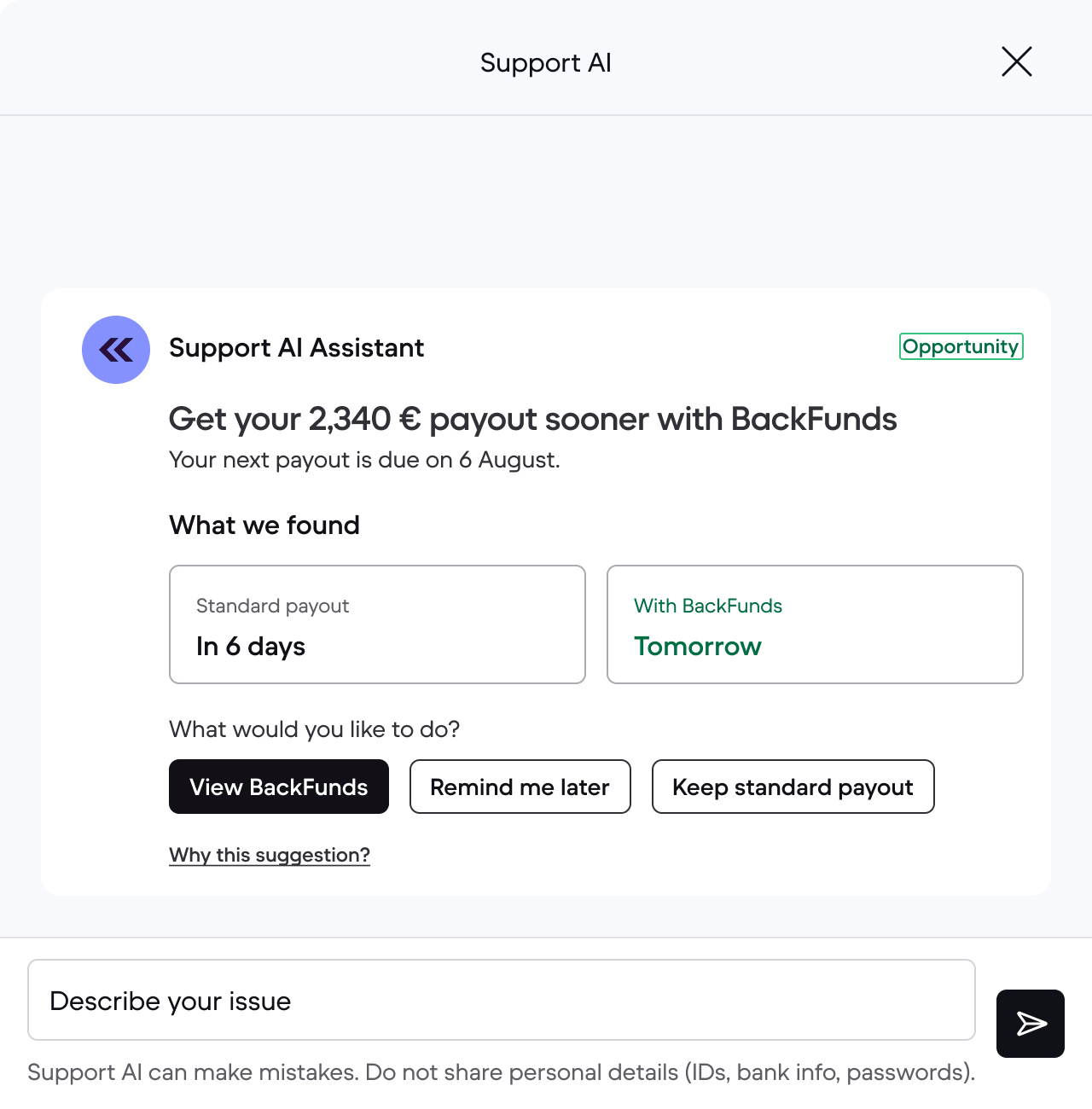
01
BackFunds introduction
- Trigger
- A pending payout
- Suggests
- Get tomorrow what’s due next week, pegged to the actual amount
- Seller decides
- View the offer, or keep the standard payout
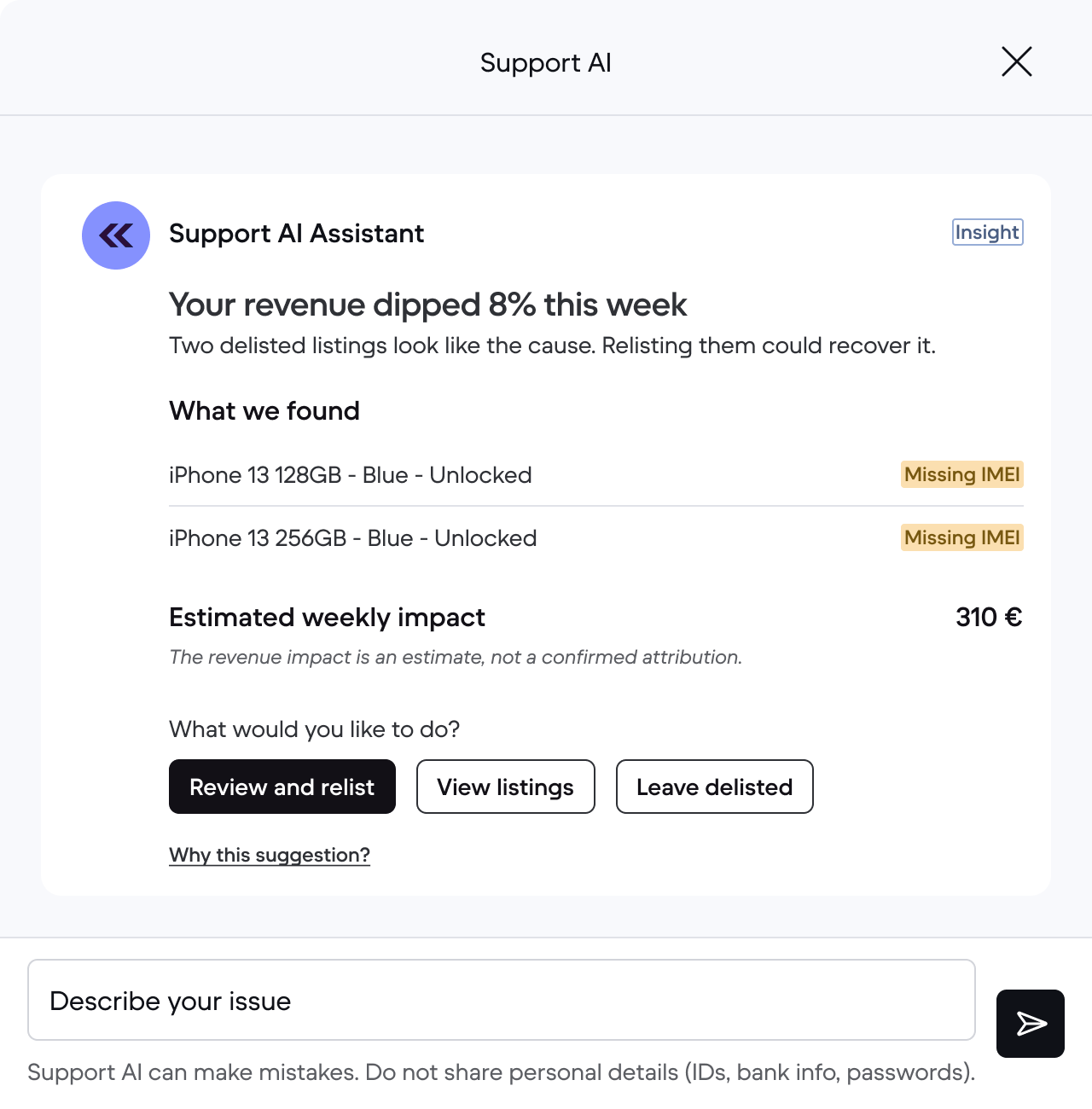
02
Revenue dip
- Trigger
- Revenue down, traced to two delisted iPhone listings
- Suggests
- Relist them, with the delisting reason shown
- Seller decides
- Relist, or leave delisted
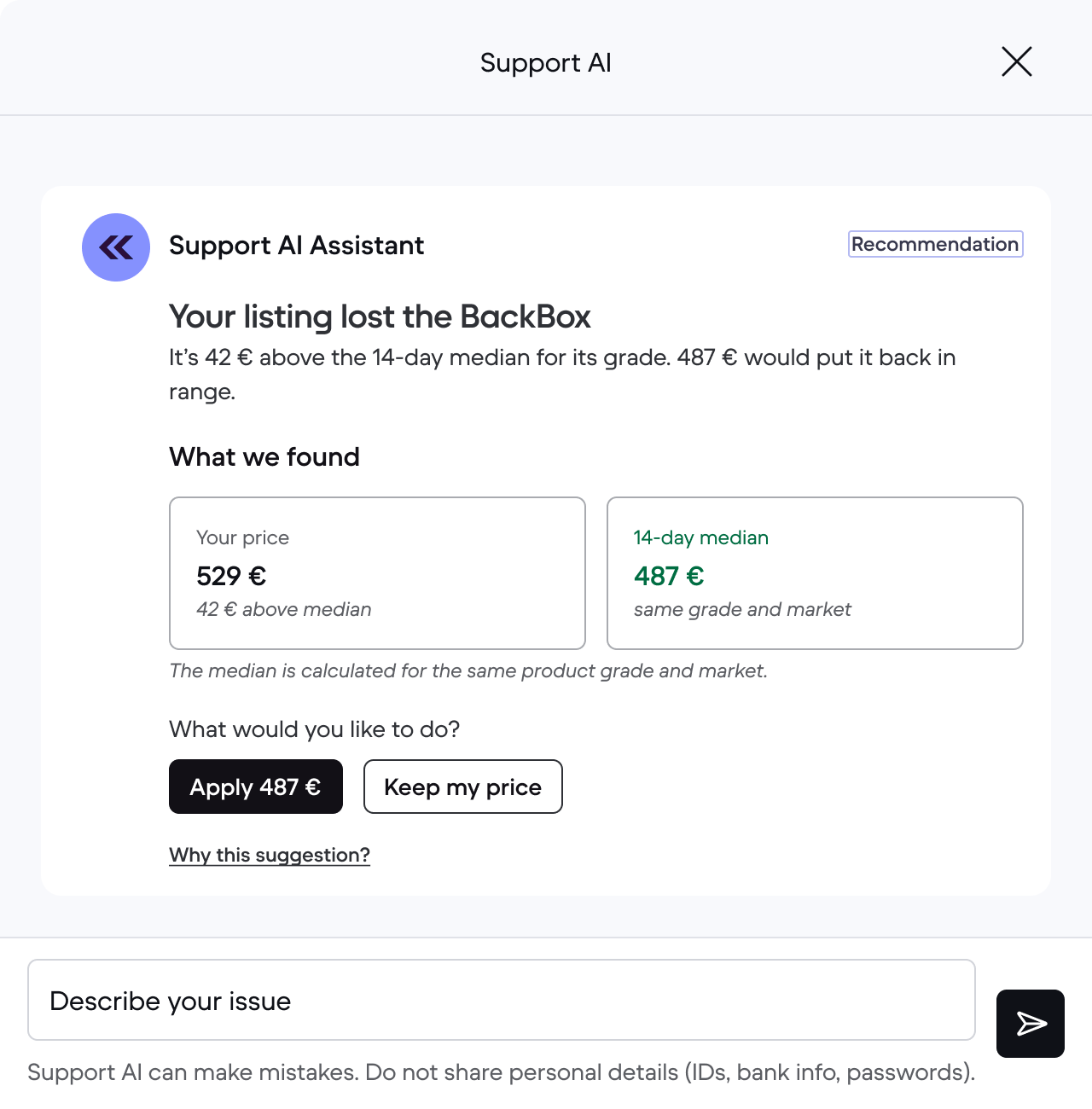
03
Price drift
- Trigger
- A listing losing the BackBox, priced above market for its grade
- Suggests
- A new price, with the math shown
- Seller decides
- Accept the price, or keep their own
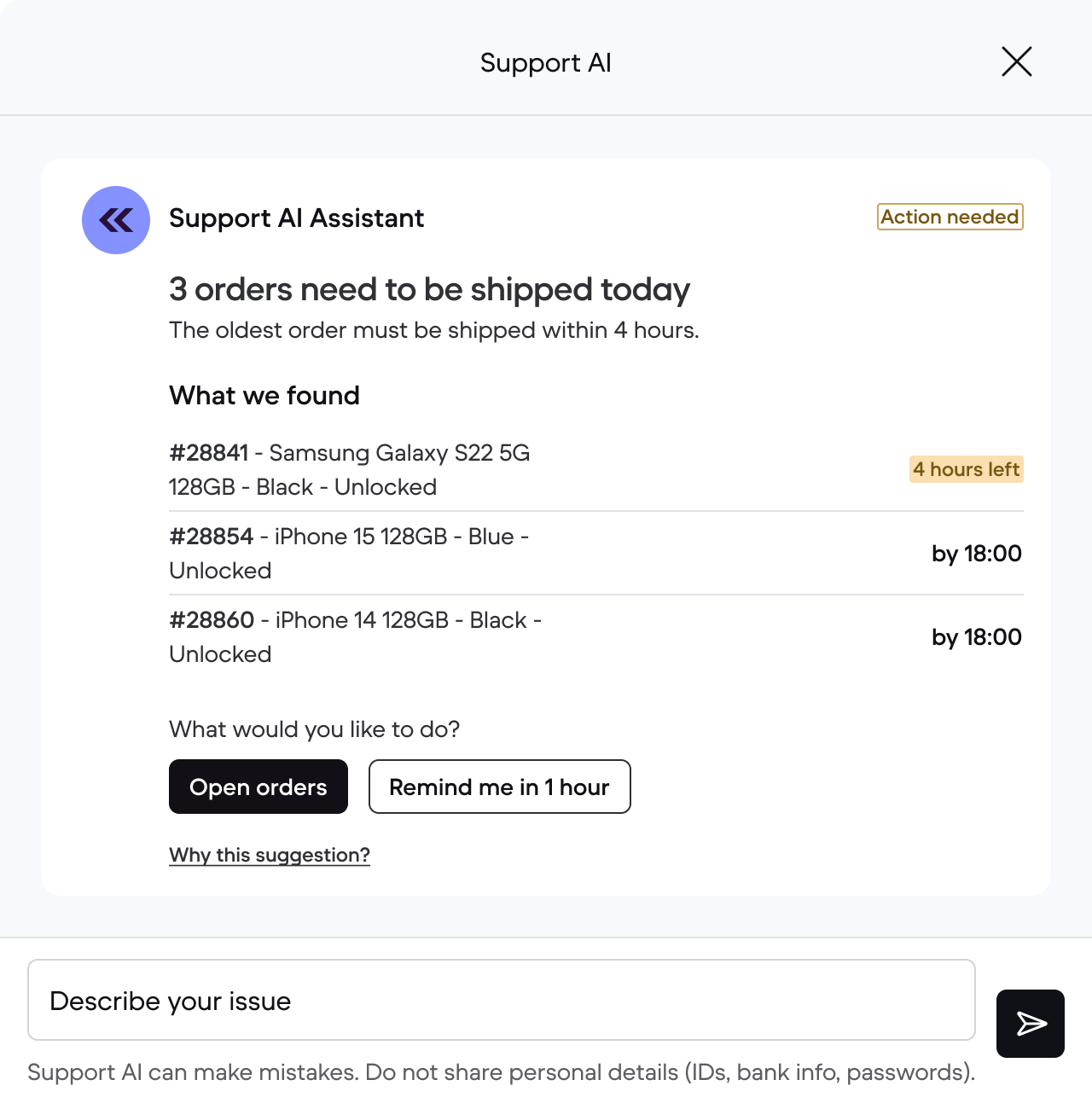
04
Ship-by risk
- Trigger
- Orders approaching today’s ship-by deadline
- Suggests
- The orders listed, oldest first
- Seller decides
- Open them, or snooze
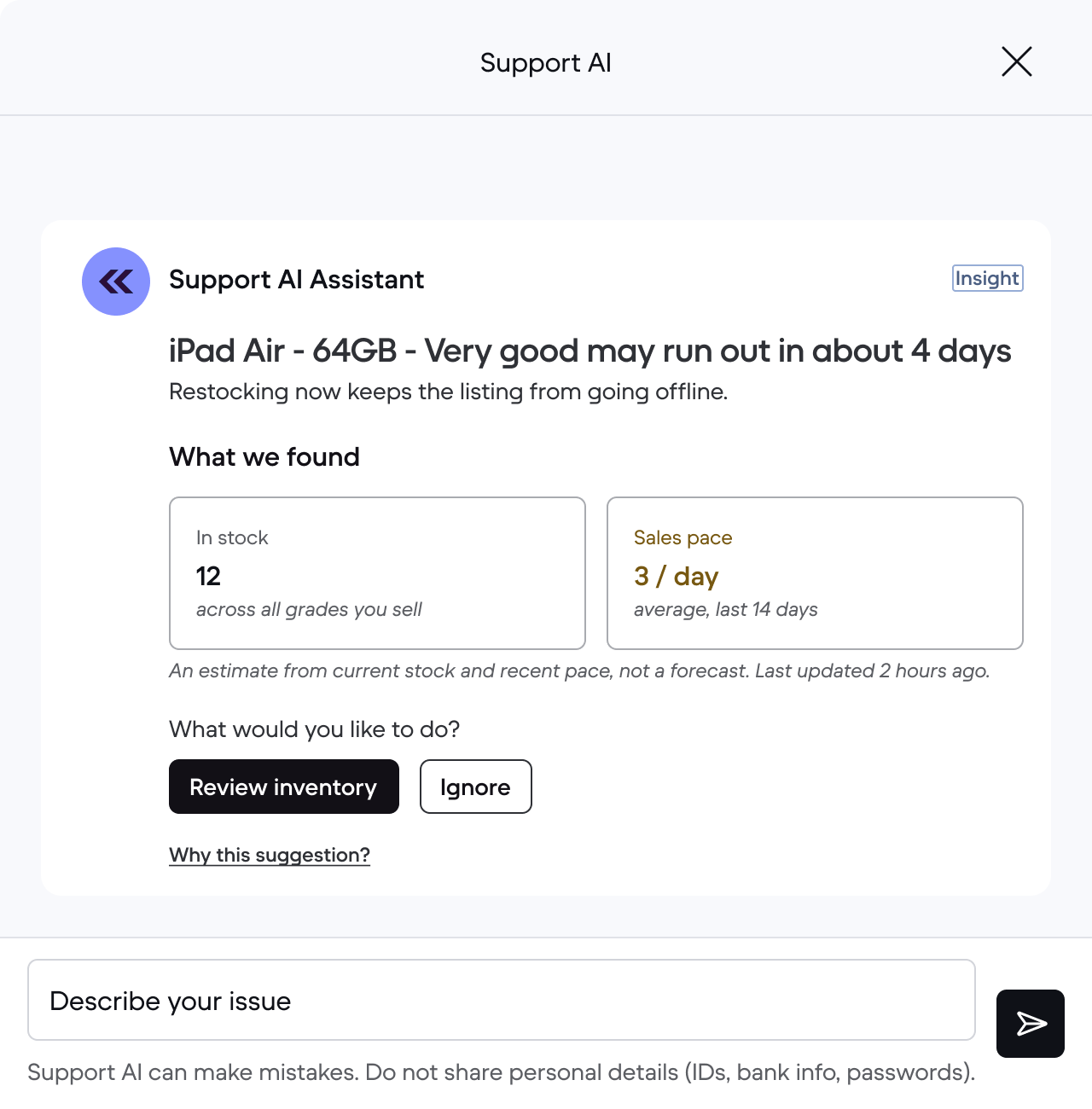
05
Stock-out ahead
- Trigger
- An SKU selling at a pace that empties stock within days
- Suggests
- Restock before the listing goes offline
- Seller decides
- Open inventory, or ignore
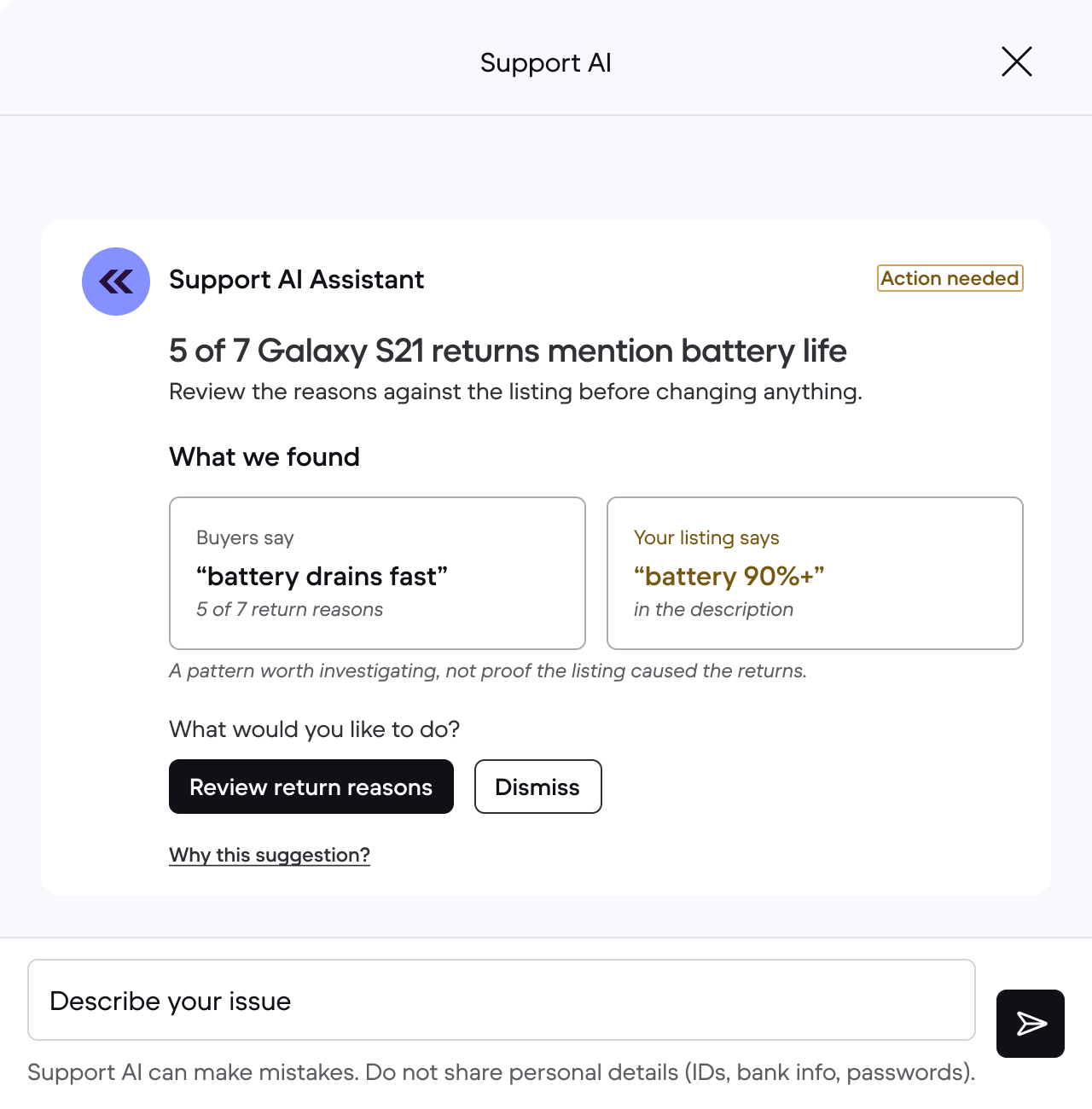
06
Returns cluster
- Trigger
- Returns concentrating on one listing, same reason cited
- Suggests
- Review the reasons against the listing’s description
- Seller decides
- Review the reasons, or dismiss
One shape, six times over, shown as concept mockups with placeholder data. The decision never leaves the seller.
Industrializing the MVP
- 44%
- Of the pilot’s first 117 conversations ended after a single exchange, with no signal whether the seller got an answer or gave up
- 8.5%
- Of pilot sellers explicitly asked the chatbot for a human
A pilot that proved demand and was not built to last: a hackathon build I worked on, taken live with about 200 UK sellers in January — answers pulled from support articles, not filtered by country, and no way to know whether a seller got what they needed. I co-wrote the spec that makes it a real product, owning the seller-facing layer: answer feedback, three-rule escalation to a human, and answers filtered to the seller’s country.
From the industrialization spec
01 If the assistant has no answer, offer a person, immediately.
02 If the seller rates the answer down, offer a person.
03 If the call fails, retry.
Three rules, deliberately simple. A stuck seller gets a human; a failed call gets another try.
The bet is still being tested
The industrialized chatbot ships under a new name, the Seller Assistant, as a hard commitment on the current roadmap, and discovery for the proactive iteration is already open. The proof so far lives in decisions and citations rather than usage numbers, which is the right kind of impact for research-to-strategy work, and the honest version of this case study says so: the posture is adopted, the prototype exists, and the adoption test is ahead.
The path from here
- Late July 2026
- Shipped: the Seller Assistant reached UK sellers with answer feedback, escalation to a human, and country-filtered answers.
- August 2026
- Every European and US seller follows, and with them the numbers the pilot could not produce: deflection, escalation, seller satisfaction.
- Then, task execution
- The strategy scopes the next phase as the move from “here is the answer” to “I’ve done it for you”: three narrow actions first, each with an audit trail and one-click undo, every one still suggest-and-confirm.
Each step up that path is gated. The evaluation framework fixes the numbers the assistant must hit before it advises on live seller data, and raises them again before it may act on a seller’s behalf.
What the assistant must earn
Set before the data arrives. Pass or fail, the next revision of this case study reports against them.
What I’d do differently so far
Flaw 01
Who answered, unknown
The survey never captured seller tier or size, so there’s no way to know whether the biggest sellers agree with the small ones — and the report has to call itself indicative rather than representative.
Flaw 02
Attitudes, not behaviour
The study measured what sellers say, not what they do. Sellers who say they want an accept step may stop wanting it the tenth time they tap it.
Run again, the survey would ship with the prototype in sellers’ hands at the same time, so the accept-or-reject finding faced real behaviour before it became strategy. That test now happens in production, which is the more expensive place to learn it.